Jesse Jackson’s 1988 Atlanta convention address and its role in unifying Democrats after primaries
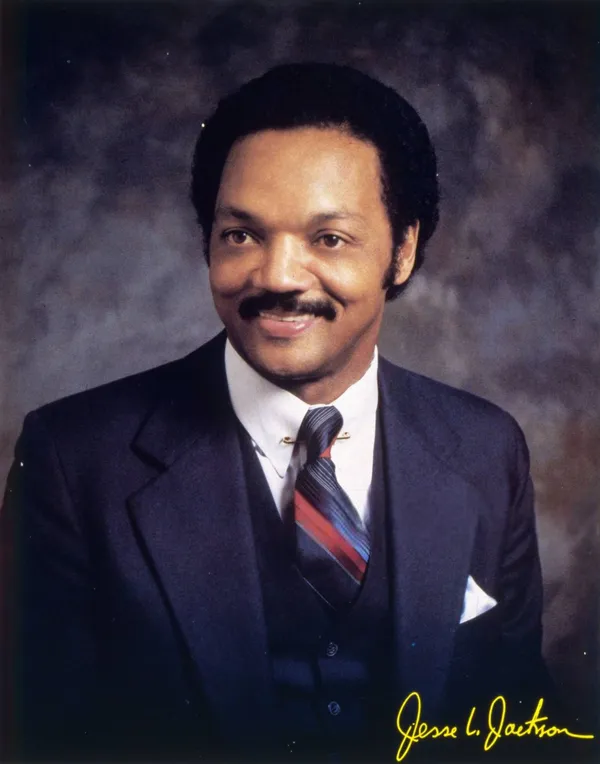
A singular convention in Atlanta
Atlanta has hosted the Democratic Party’s national convention once: the 1988 Democratic National Convention, held July 18–21 at the Omni Coliseum. On the convention’s second night, July 19, the Rev. Jesse L. Jackson took the stage to deliver a nationally watched address after finishing second to Massachusetts Gov. Michael Dukakis in the delegate count during the nominating contest.
The moment placed Jackson—already a central figure in modern U.S. civil-rights politics and a major presidential contender—at the center of the party’s effort to shift from intraparty competition to general-election unity.
The speech’s core message: “common ground”
Jackson framed the convention hall as a cross-section of the country and used the language of coalition-building to argue that political differences could be bridged through shared interests. Early in the address, he described the party’s diversity in explicitly multiracial terms, linking it to the “Rainbow Coalition” theme that became closely associated with his national political rise.
He returned repeatedly to “common ground,” reinforcing the point with extended metaphors designed to translate ideological conflict into practical necessity. Among them were images of opposing forces that still share a stake in survival and stability, and a comparison of different immigrant and enslaved journeys to the United States that ended in a shared national present.
- He argued that unity was not the same as uniformity, stressing mutual dependence despite competing viewpoints.
- He presented the general-election task as collective, emphasizing overlap in lived stakes—work, safety, and civic belonging.
- He explicitly acknowledged differences of class, background, religion, and region while emphasizing shared national membership.
Tributes and a broader civil-rights frame
Jackson also anchored his political message in remembrance, citing people and events tied to voting rights and racial terror in U.S. history. In doing so, he placed the act of political participation—especially voting—inside a continuum of sacrifice and struggle, connecting convention politics to a longer civic arc.
Jackson’s address blended personal biography, historical references, and party-building language to press for unity after a hard-fought primary season.
Positioning after a contested nomination fight
A notable feature of the speech was Jackson’s treatment of Dukakis. While making clear that their backgrounds and experiences diverged sharply, he praised Dukakis’s campaign and urged the party to unify behind the ticket. The address served as both a summation of Jackson’s own candidacy and a bridge to the campaign’s next phase.
Dukakis and his running mate, U.S. Sen. Lloyd Bentsen of Texas, ultimately lost the 1988 general election to then–Vice President George H.W. Bush and Indiana Sen. Dan Quayle. But in Atlanta, Jackson’s speech functioned as a key convention moment: a bid to define shared priorities and keep a broad Democratic coalition intact heading into November.